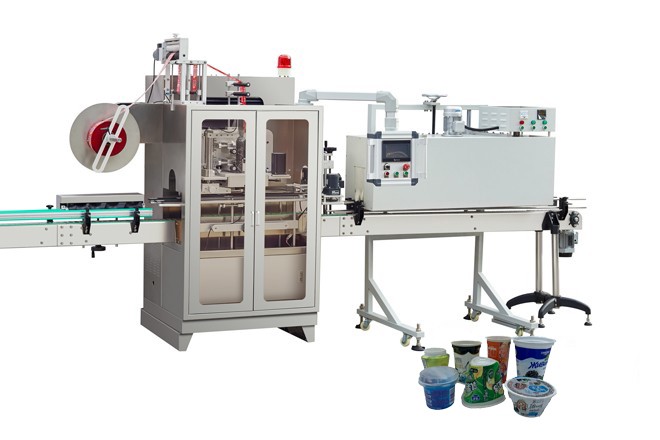
Yogurt cup packaging presents unique challenges for shrink sleeve application due to the thin-walled construction of typical dairy containers. Unlike rigid beverage bottles, yogurt cups made from PS, PP, or PET are lightweight and prone to deformation under excessive heat. A shrink sleeve applicator for yogurt cup lines must therefore balance precise label placement with gentle thermal processing to preserve cup integrity.
Cup geometry varies significantly across product formats. Round cups, conical cups, square cups, and triangular cups each require different sleeve dimensions, cutting positions, and shrink profiles. The applicator must handle these shape variations without extensive manual adjustment, as dairy producers often run multiple cup formats within a single production shift. Quick changeover between cup sizes is essential to minimize downtime.
Heat management is the most critical factor in yogurt cup sleeve labeling. Steam-based shrink tunnels can leave moisture on the cup surface, creating conditions for bacterial growth inside the container before filling. Electric hot air tunnels with 360-degree circulating systems offer a drier alternative, maintaining temperatures below 90 degrees Celsius to prevent cup distortion while achieving uniform sleeve adhesion.
Material compatibility also affects labeling outcomes. Polyolefin sleeves made from the same plastic family as the cup support recyclability, allowing the entire package to be processed in a single recycling stream. Lightweight OPS films provide high clarity and controlled shrinkage, but their stiffness must be matched to the cup's flexibility to avoid edge lifting or wrinkling during the shrink process.
Contact: Kris.Jiang
Phone: +86-13512184818
E-mail: Kris.jiang@sr-packing.com
Add: No. 18, Changting Road, Fengxian District, Shanghai, China