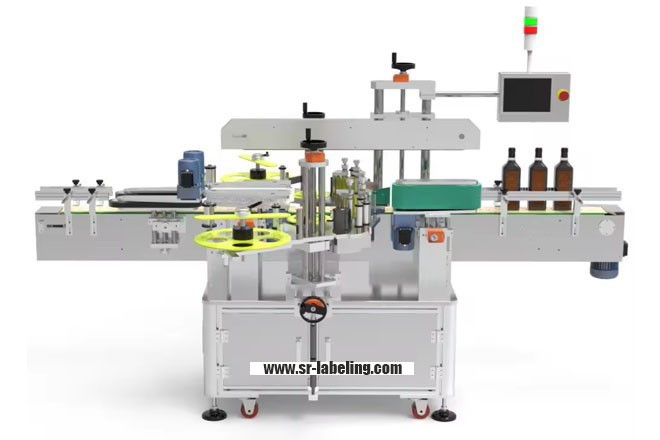
The infant formula and dairy nutrition sector operates under some of the most stringent quality control standards in the global manufacturing landscape. Unlike standard beverage or food packaging, milk powder cans demand absolute precision, sterility, and traceability. As consumer expectations for product safety rise alongside increasingly rigorous national standards (such as the newly implemented GB/T 26993-2025), the milk powder cans labeling machine has evolved from a simple applicator into a sophisticated, AI driven quality assurance hub. This evolution is redefining how manufacturers approach speed, accuracy, and data integration on the production floor.
The Shift to AI Powered Visual Inspection
In modern high speed dairy facilities, the labeling process is no longer just about adhesion; it is about verification. Advanced labeling lines are now integrating Artificial Intelligence (AI) visual detection systems directly into the workflow. These systems utilize high resolution industrial cameras and deep learning algorithms to inspect every single can in milliseconds. They go beyond simple presence detection, identifying microscopic defects such as transparent label bubbles, slight wrinkles, or misaligned barcode printing that traditional sensors might miss. By transitioning from random spot checks to 100% full cover inspection, manufacturers can achieve a "zero defect" outflow policy. This technological leap ensures that every can leaving the line not only meets aesthetic standards but also carries accurate, legible production dates and batch codes.
Navigating Complex Can Geometries with Servo Precision
Milk powder packaging often involves complex container designs, including oval tins, square canisters, and cans requiring dual-sided labeling (front and back). Traditional mechanical labeling heads often struggle with these irregular shapes, leading to skewed labels or air pockets. The latest generation of milk powder cans labeling machines utilizes fully servo driven control systems combined with advanced contour following technology. These machines can automatically compensate for position errors caused by the varying curvature of different can bodies.
Data Driven Traceability and Smart Factory Integration
As the industry moves toward Industry 4.0, the labeling machine has become a vital node in the smart factory ecosystem. It acts as a data collection point, linking physical packaging with digital information. Modern systems are capable of generating and verifying unique QR codes or digital watermarks on every can, facilitating a complete data loop from production to consumer. This data is uploaded in real time to cloud based quality management platforms, allowing plant managers to track production batches, analyze defect trends, and optimize equipment performance remotely. This level of connectivity not only streamlines compliance with government regulations regarding food identification but also empowers brands to engage directly with consumers through digital label interactions, turning a regulatory requirement into a marketing asset.
Contact: Kris.Jiang
Phone: +86-13512184818
E-mail: Kris.jiang@sr-packing.com
Add: No. 18, Changting Road, Fengxian District, Shanghai, China