Sleeve labeling on PET cups is no longer just a decorative finishing step. It is becoming part of a broader packaging strategy that balances brand presentation, moisture resistance, tamper evidence, production flexibility, and end-of-life considerations. As brands move toward more frequent product launches, shorter runs, and more complex retail requirements, the PET cups sleeve labeling machine is being evaluated not only for speed but also for placement accuracy, thermal control, changeover efficiency, and compatibility with evolving sleeve materials.
PET Cup Packaging Is Growing Across Multiple Categories
PET cups are used in a wide range of packaged goods, from iced coffee and cold brew beverages to yogurt alternatives, smoothies, puddings, dips, desserts, and single-serve food portions. Their transparent or semi-transparent appearance can help showcase product color and texture, while their lightweight construction supports efficient transport and handling.
However, PET cups also present a labeling challenge. Their tapered shapes, thin walls, smooth surfaces, and heat sensitivity mean that label application must be precise. A sleeve labeling system designed for rigid bottles may not deliver the same level of control on a lightweight PET cup, especially when production speeds are high and container formats change frequently.
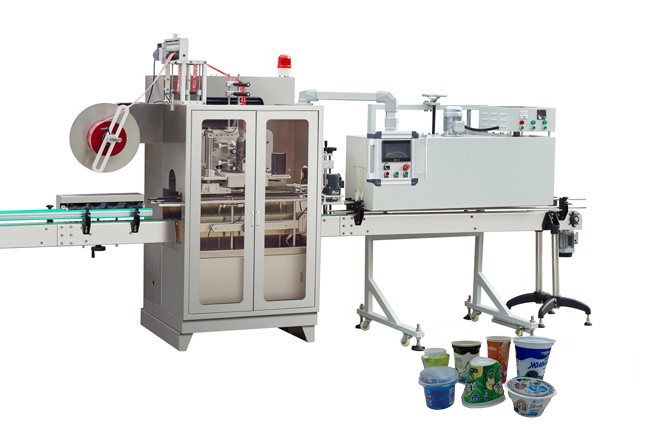
The PET cups sleeve labeling machine addresses this by applying pre-formed shrink sleeves with consistent positioning and controlled heat application. This allows brands to maintain strong visual identity across different cup sizes and product lines without redesigning the container itself.
Tapered Shapes Require More Than Basic Sleeve Application
One of the most important factors in PET cup sleeve labeling is container geometry. Unlike straight-walled bottles, many PET cups taper from rim to base. That taper means the sleeve must shrink evenly across a changing diameter without forming wrinkles, gaps, bridges, or uneven tension lines.
If sleeve cutting, placement, or heat application is not matched to the cup profile, the finished label may look distorted or inconsistent. On clear or glossy PET cups, these defects can be especially visible because the sleeve sits directly against a smooth, reflective surface.
Modern PET cups sleeve labeling machines address this through adjustable forming guides, servo-controlled sleeve feed, precise cutting systems, and shrink tunnels calibrated to the specific dimensions of the cup. The goal is to produce a clean, consistent finish that supports both branding and production reliability.
Thermal Control Must Protect Thin PET Walls
PET cups are generally lighter and more heat-sensitive than rigid bottles. During sleeve shrinking, excessive or uneven heat can affect the cup itself, causing deformation, rim distortion, or changes in container shape. Insufficient heat, on the other hand, can leave the sleeve loose, wrinkled, or poorly conformed to the cup surface.
This makes thermal control one of the most important performance factors for a PET cups sleeve labeling machine. The shrinking process must apply enough energy to tighten the sleeve film without transferring excessive heat into the cup wall.
Advanced systems use multi-zone heat tunnels, controlled airflow, and adjustable temperature profiles to manage this balance. For producers running lightweight PET cups, recycled-content cups, or cups with thinner walls, precise thermal management becomes especially important because small variations can affect both label quality and container integrity.
Contact: Kris.Jiang
Phone: +86-13512184818
E-mail: Kris.jiang@sr-packing.com
Add: No. 18, Changting Road, Fengxian District, Shanghai, China