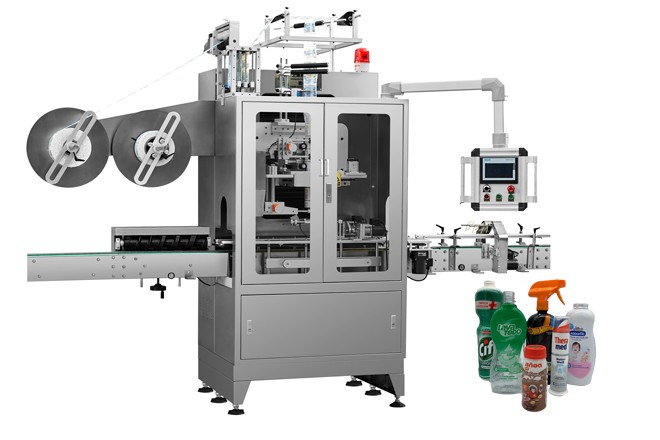
Packaging requirements vary considerably between industries, product categories, and manufacturing environments. From beverage bottles to cosmetic containers and household chemical packaging, manufacturers need labeling solutions that can accommodate different product designs while maintaining a consistent appearance. Shrink sleeve labeling machines have become an important part of these operations because they allow printed film labels to fit closely around containers of various shapes.
Expanding Applications of Shrink Sleeve Labeling
Shrink sleeve labeling technology is used in many industries where product appearance and packaging identification are important.
In beverage production, sleeve labels are commonly applied to water bottles, juice containers, and other bottled products. Their ability to cover a large portion of the container provides additional space for product information, graphics, and branding elements.
In the cosmetics industry, uniquely shaped bottles and jars often require labeling methods that can follow curved surfaces. Shrink sleeves provide a practical option for packaging products with different designs and dimensions.
Household cleaning products and personal care items also benefit from this technology. Containers with handles, tapered bodies, and irregular profiles can use specially designed sleeves to achieve a close-fitting label when the material and application process are properly matched.
Understanding the Complete Labeling Process
A typical shrink sleeve labeling process involves several coordinated operations.
First, printed sleeve film is supplied to the labeling machine in roll form. The film passes through a feeding mechanism before being cut into individual sleeves according to the required dimensions.
Next, the cut sleeves are positioned and placed around the corresponding containers. Accurate positioning is important because the sleeve must be correctly aligned before entering the shrinking stage.
After sleeve application, containers move through a heating section. Depending on the equipment configuration, hot air or steam can be used to apply controlled heat, causing the film to contract around the container.
The finished products are then transferred to the next packaging stage for inspection, packing, or further processing.
Each stage contributes to the final packaging result, making proper coordination between film handling, cutting, application, and shrinking essential.
Common Factors Affecting Label Appearance
Achieving an attractive shrink sleeve finish requires attention to several production details.
Film thickness and shrink characteristics influence how the label responds to heat. Incorrect material selection may result in excessive deformation or insufficient shrinkage.
Container geometry also affects the final appearance. Bottles with complex curves or significant differences in diameter may require carefully developed sleeve dimensions to achieve uniform coverage.
Printed artwork is another important consideration. Graphics, text, and product information should be designed with the container shape and expected film shrinkage in mind. Distortion can occur when important design elements are placed in areas with significant shrinkage.
Heating conditions must also be properly controlled. Temperature, exposure time, and airflow distribution can all influence the final label appearance.
Contact: Kris.Jiang
Phone: +86-13512184818
E-mail: Kris.jiang@sr-packing.com
Add: No. 18, Changting Road, Fengxian District, Shanghai, China